An investor recently showed me two properties side by side. Both had roughly the same net operating income, around $180,000 a year. One was a small industrial warehouse. The other was a downtown office building three times the size. On paper, the NOI figures looked equally strong. In practice, one of those numbers represented a healthy, well run asset, and the other represented a building quietly underperforming relative to its size and expense load.
This is the trap with asking what is a good NOI for commercial property in isolation. NOI is not a number you can judge on its own. It only means something in relation to property value, property type, size, location, and how it compares to similar assets. Here is how to actually evaluate whether your NOI is strong, weak, or somewhere in between.
What NOI Measures
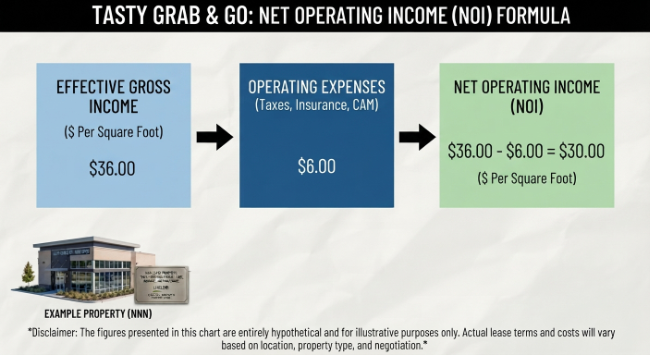
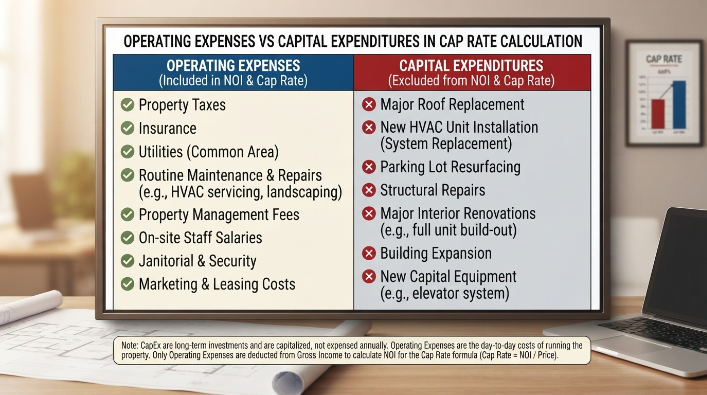
Net operating income is the income a property generates after operating expenses are deducted, but before financing costs, capital expenditures, and income taxes come into play.
NOI = Effective Gross Income − Operating Expenses
Effective gross income is your total rental income after subtracting a realistic vacancy and credit loss allowance. Operating expenses typically include property taxes, insurance, maintenance, utilities not covered by tenants, and management fees. NOI deliberately excludes mortgage payments and capital improvements, because it is meant to represent the property’s underlying operating performance independent of how it is financed.
Why “Good NOI” Is a Relative Question, Not an Absolute One
A $200,000 NOI on a $2 million property is a very different story than a $200,000 NOI on a $6 million property. The first implies a 10% cap rate. The second implies roughly 3.3%. Same dollar figure, dramatically different performance relative to the capital invested. This is exactly why a practical way to look at NOI is always in context: as a percentage of property value, as a comparison against similar assets in the same submarket, and as a trend over time rather than a single snapshot.
What Makes NOI Strong or Weak
A few factors consistently separate a strong NOI from a weak one, regardless of property type.
Vacancy and tenant stability. A property with long term, creditworthy tenants tends to produce a more reliable NOI than one with high turnover, even if the current dollar figure looks similar. A vacant unit does not just reduce income for that period, it also increases marketing and turnover costs that eat into NOI.
Expense ratio. This is operating expenses as a percentage of effective gross income. A property with a high expense ratio, meaning expenses eat up a large share of income, generally reflects an older building, deferred maintenance catching up, or inefficient management. Lower expense ratios, all else equal, tend to reflect stronger NOI performance.
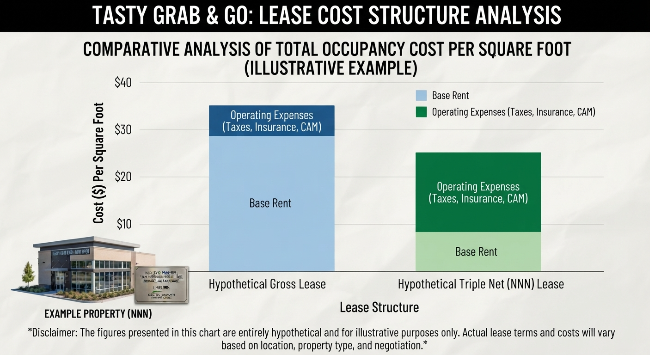
Lease structure. As covered in more detail in a related guide on triple net versus gross leases on this site, properties where tenants absorb more operating costs directly tend to show a more stable NOI for the owner, since rising expenses get passed through rather than absorbed by the landlord.
Market rent alignment. If in place rents sit meaningfully below current market rents, NOI understates the property’s real income potential, and vice versa if rents are above market and due for correction at renewal.
Benchmarks by Property Type
Rather than offering one universal number, it helps to understand how NOI dynamics differ across the major commercial property categories. These are general tendencies, not fixed rules, and they shift with market cycles. Also read How to Calculate Cap Rate on Commercial Property.
Office
Office NOI has faced more pressure in recent years due to elevated vacancy in many markets and higher tenant improvement and leasing commission costs needed to attract and retain tenants. A strong office NOI today typically reflects a well located building with committed, creditworthy tenants on longer term leases, since shorter term or speculative leasing adds risk to future income.
Retail
Retail NOI performance varies heavily by format. Single tenant net leased retail, especially to national credit tenants, tends to produce very stable NOI because expenses are largely passed through. Multi tenant retail centers carry more variability, since NOI depends on the tenant mix and how well anchor and inline tenants are performing.
Industrial
Industrial and logistics properties have generally been a bright spot. According to CoStar Group’s late 2025 commercial real estate forecast, industrial assets have experienced cap rate compression since the latter half of 2024, particularly for high quality assets where vacancies have peaked and rent growth is accelerating. Rising rent growth alongside stabilizing vacancy generally supports stronger, more predictable NOI trajectories for well positioned industrial assets heading into 2026.
Multifamily
Multifamily NOI tends to be judged heavily on operating efficiency, since expense categories like utilities, maintenance, and staffing are more controllable than in some other property types. A well managed multifamily asset with disciplined expense control and low turnover typically shows steadier NOI growth than a comparable asset with high resident turnover.
NOI Margin: A Useful Secondary Metric
NOI margin, calculated as NOI divided by effective gross income, tells you what percentage of collected income actually makes it to the bottom line before financing. A property collecting $500,000 in effective gross income with $300,000 in NOI has a 60% NOI margin. Comparing NOI margin across similar properties in the same category can reveal operational efficiency differences that the raw NOI dollar figure alone would hide.
Real World Example: Same Income, Different Story
Return to the two properties mentioned earlier. Assume the industrial warehouse is valued at $2 million and produces $180,000 in NOI, an implied 9% cap rate. The downtown office building is valued at $4.5 million with that same 180,000NOI,animplied4%caprate.Withoutcontext,bothpropertiesshow”180,000 in NOI.” Once you factor in property value, one is performing well above typical expectations for its asset class, and the other is underperforming and likely needs a leasing or expense management strategy to close the gap. This is a simplified, hypothetical comparison intended to illustrate the point, not a reflection of current market averages for either property type.
Common Mistakes When Evaluating NOI
- Judging NOI as a flat dollar figure instead of relative to property value. Always calculate the implied cap rate to put NOI in context.
- Ignoring the trend over time. A single year’s NOI can be misleading. Look at the trailing three years to spot whether income is growing, flat, or declining.
- Overlooking deferred maintenance. A property can show a strong current NOI while quietly deferring necessary capital repairs that will eventually hit cash flow.
- Comparing NOI across property types without adjusting for typical expense loads. A multifamily property and an office building carry very different expense structures, even at similar income levels.
- Using pro forma projections instead of trailing actual income when assessing “good” NOI. A projected number is a forecast, not a performance measurement.
Frequently Asked Questions
What is considered a good NOI for commercial property? There is no single dollar figure that qualifies as good. NOI needs to be evaluated relative to property value, property type, and comparable assets in the same market to determine whether it represents strong performance.
How do I calculate NOI? Subtract operating expenses from effective gross income (total rental income after a realistic vacancy allowance). Exclude mortgage payments, capital expenditures, and income taxes from the calculation.
Does a higher NOI always mean a better investment? Not necessarily. A higher NOI on a much larger or more expensive property can still represent a weaker return than a smaller NOI on a lower priced asset. Always compare NOI relative to value.
What is NOI margin and why does it matter? NOI margin is NOI divided by effective gross income. It shows what share of collected income reaches the bottom line and helps compare operational efficiency across similar properties.
How does property type affect what counts as good NOI? Different property types carry different typical expense ratios and income stability profiles, so benchmarks that apply to industrial assets do not directly translate to office or retail properties.
Should I trust a seller’s projected NOI figure? Treat projected or pro forma NOI with caution and request trailing twelve month actual operating statements to verify the property’s real performance before relying on any forward looking number.
Conclusion
Figuring out what is a good NOI for commercial property means resisting the urge to judge a single dollar figure on its own. The real answer comes from comparing NOI against property value, tracking it over time, and understanding how your property type typically performs relative to expenses and vacancy. A property with a modest NOI but a strong margin and a rising trend can be a far better investment than one with a larger NOI dragged down by high expenses or unstable tenancy. Pull the trailing financials, calculate the implied cap rate, and compare against similar assets before deciding whether the number in front of you is actually good.
Leave a Reply