If you have ever tried to figure out how to value a commercial property on your own, you already know the frustration. Ask three appraisers the same question and you might get three different numbers, all defensible, all a little confusing if you are not fluent in cap rates and net operating income. That is not because anyone is wrong. It is because commercial valuation is built around judgment, not just formulas.
One practical way I would approach this topic is to strip away the jargon first and rebuild it piece by piece, the way an owner actually experiences it: what information do you need, what math is happening behind the scenes, and where does professional judgment matter more than the spreadsheet.
What Commercial Property Valuation Actually Means
Valuing a commercial property means estimating what it is realistically worth today, based on the income it produces, what similar properties have sold for, and what it would cost to rebuild it. Residential valuation leans heavily on comparable home sales. Commercial valuation leans heavily on income, because a commercial property’s real job is to generate cash flow for its owner.
This distinction matters because it changes how you think about improvements, tenants, and even minor vacancy. A vacant bedroom in a house does not change its value much. A vacant unit in a small retail strip absolutely does.
Information You Need Before You Start
Before running any numbers, gather:
- Current rent roll and lease terms
- Trailing twelve months of income and operating expenses
- Recent comparable sales in the immediate submarket
- Property condition notes, including deferred maintenance
- Local vacancy trends for the property type
- Zoning and permitted use
Without this, any valuation is a guess dressed up in decimal points. Also read What Is a Good NOI for Commercial Property?.
The Income Approach
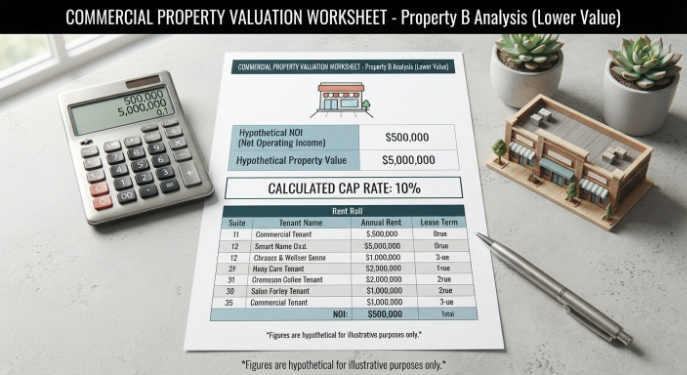
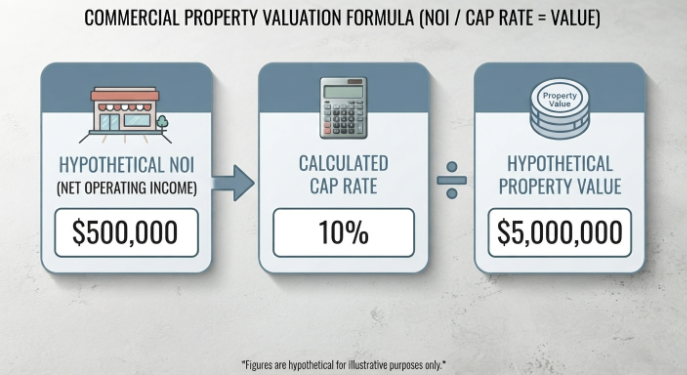
The income approach is the backbone of how to value a commercial property because it reflects what most buyers actually care about: reliable cash flow. It starts with net operating income, or NOI, which is gross rental income minus vacancy loss and operating expenses (not including mortgage payments).
NOI is then divided by a capitalization rate, or cap rate, which represents the return an investor expects for that type of property in that market.
Formula: Property Value = NOI ÷ Cap Rate
A lower cap rate implies a higher value for the same income, because the market is willing to accept a lower return in exchange for perceived stability. A higher cap rate signals more risk and produces a lower value for the same NOI.
The Sales Comparison Approach
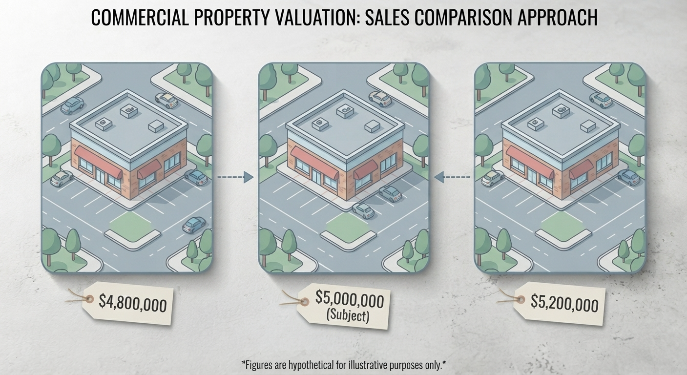
This approach looks at recent sales of similar properties nearby, adjusting for size, condition, age, and location. It works best when there are enough comparable transactions to draw a reliable pattern, which is easier for smaller retail or multifamily assets than for a specialized industrial facility or a single tenant office building.
A gross rent multiplier, or GRM, sometimes supplements this approach for smaller income properties. GRM compares sale price to gross rental income rather than net income, so it is a rougher tool, useful for a quick sanity check rather than a final number.
The Cost Approach
The cost approach asks a different question: what would it cost to replace this property today, accounting for depreciation and land value? It is most useful for newer buildings, special purpose properties (schools, churches, self storage facilities) where comparable sales and income data are limited, or insurance related valuations.
How NOI, Occupancy, and Lease Quality Affect Value
Three factors quietly move every commercial valuation more than owners expect.
NOI is the engine. Small improvements in rental income or expense control compound directly into value once divided by the cap rate.
Occupancy affects both current income and perceived risk. A property at 60 percent occupancy is not just earning less today, it also reads as riskier to a buyer or lender, which can push the cap rate higher and the value lower.
Lease quality, meaning remaining lease term, tenant creditworthiness, and rent escalation clauses, tells a buyer how predictable that income really is. A single tenant with eight years remaining on an investment grade lease is worth more per dollar of NOI than the same NOI from a rent roll full of month to month tenants.
Step by Step Hypothetical Valuation Example
Let’s walk through a small retail strip, purely as a hypothetical example.
| Line Item | Amount |
| Gross Potential Rent | $240,000 |
| Vacancy and Credit Loss (5%) | ($12,000) |
| Effective Gross Income | $228,000 |
| Operating Expenses (38%) | ($86,640) |
| Net Operating Income | $141,360 |
If comparable properties in this submarket are trading at a 7 percent cap rate:
Property Value = $141,360 ÷ 0.07 = $2,019,428, rounded to roughly $2,020,000
Now compare that to the sales comparison approach. If three similar strip centers nearby recently sold for between $190 and $215 per square foot, and this property is 10,000 square feet, that suggests a value between $1,900,000 and $2,150,000. Since both approaches land in a similar range, that convergence gives an owner more confidence in the number.
Why Two Professionals Can Value the Same Property Differently
This is one of the most common points of confusion for owners. Two qualified appraisers can reach different conclusions on the same commercial property because they may select slightly different comparable sales, apply different cap rate assumptions, or weight the three approaches differently. Neither is necessarily wrong. Valuation is a range supported by evidence, not a single fixed truth waiting to be discovered.
Asking Price vs Market Value vs Appraised Value vs Investment Value
These four terms get used interchangeably, which causes real confusion:
- Asking price is simply what the seller wants, which may or may not reflect the market.
- Market value is the price a well informed buyer and seller would likely agree on in a normal transaction.
- Appraised value is a formal, documented opinion of value prepared by a licensed appraiser, often required by lenders.
- Investment value is what the property is worth specifically to one buyer, based on their financing, tax situation, or strategic goals, which can be higher or lower than market value.
Common Valuation Mistakes Owners Make
- Using gross rent instead of NOI to estimate value
- Applying a cap rate from a different property type or market
- Ignoring deferred maintenance in the cost approach
- Assuming asking price reflects market value
- Overlooking how lease term and tenant quality affect risk
When a Professional Appraisal Is Appropriate
Understanding how to value a commercial property yourself is genuinely useful for early stage decisions such as whether to make an offer, refinance, or list a property. But a licensed appraisal is appropriate, and often required, for financing, estate matters, tax appeals, litigation, or partnership disputes. Cap rate assumptions in particular shift from quarter to quarter, which is why it helps to check them against current commercial real estate market research rather than relying on figures that are a year or two out of date. The Appraisal Institute is also a useful resource for understanding when a formal, licensed appraisal is the right call.
Real World Example
Consider a hypothetical small business owner named Maria, who owns a 6,000 square foot mixed use building with two ground floor retail tenants and three office suites above. She wants to know whether refinancing makes sense. Using the income approach, her NOI of $98,000 divided by a market cap rate of 7.5 percent suggests a value near $1,307,000. Before approaching her lender, she also checks two nearby comparable sales, which support a similar range. This gives her a realistic starting point for the conversation, even though the lender will ultimately order its own independent appraisal.
FAQ
How do you calculate the value of a commercial property? Most valuations rely on the income approach (NOI divided by cap rate), supported by the sales comparison approach and, where relevant, the cost approach.
What is a good cap rate for commercial property? It depends heavily on property type, location, and tenant quality. Lower cap rates generally reflect lower perceived risk, while higher cap rates reflect higher risk or lower demand.
Is NOI the same as cash flow? No. NOI excludes mortgage payments, while cash flow to the owner accounts for debt service, capital reserves, and other non operating items.
Can I value a commercial property without hiring an appraiser? You can build a reasonable estimate using the methods above, which is useful for early decision making, but a licensed appraisal is typically required for financing and other formal purposes.
Why did my property appraise lower than I expected? This often comes down to cap rate assumptions, comparable sales selection, unaddressed deferred maintenance, or weaker lease terms than the owner assumed.
Does vacancy always lower commercial property value? Generally yes, since it reduces NOI and can signal higher risk to buyers and lenders, though a temporary vacancy in an otherwise strong market may have less impact than chronic vacancy.
What is the difference between market value and investment value? Market value reflects what a typical buyer would pay. Investment value reflects what the property is worth to a specific buyer based on their own financial position and goals.
Conclusion
Learning how to value a commercial property is less about memorizing a formula and more about understanding how income, risk, and market evidence fit together. The income approach will usually anchor your number, the sales comparison approach will help confirm it, and the cost approach fills in the gaps where the other two fall short. None of this replaces a licensed appraisal when one is required, but it gives you a genuinely useful starting point the next time you are staring at a rent roll trying to figure out what a property is really worth.
Leave a Reply