Two tenants can sign leases with identical base rent figures and end up paying completely different amounts each month, simply because of how the lease is structured. That is the part people miss when they first compare a triple net lease vs gross lease: the headline rent number tells you almost nothing on its own. What matters is who pays for what, and how predictable your total occupancy cost is going to be over the term of the lease.
This comes up constantly with new tenants and first time commercial landlords, so let’s break down what each structure actually means, who tends to benefit from each one, and how to think through the decision if you are on either side of the table.
What Is a Gross Lease?
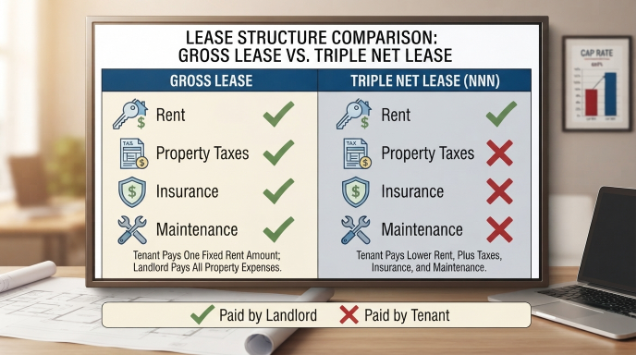
Under a gross lease, the tenant pays a single, all inclusive rent figure, and the landlord is responsible for covering property taxes, insurance, and maintenance out of that rent. As Cornell Law School’s Legal Information Institute describes it, a gross lease means the landlord includes maintenance fees, taxes, and other expenses in their calculation of the rent, which can result in higher headline rent but also lower liability for the tenant against changing costs (source: Cornell Law School, https://www.law.cornell.edu/wex/gross_lease).
The appeal for a tenant is simplicity. One number, billed monthly, with no surprise invoices for a new roof or a spike in property tax assessments. The tradeoff is that the base rent is usually priced higher to account for the landlord absorbing those variable costs.
Modified Gross Lease
Many leases marketed as “gross” are actually modified gross leases, where some expenses, often utilities or a share of common area maintenance, are carved out and billed separately to the tenant. This is worth clarifying line by line before signing anything, because “gross lease” on a listing sheet does not always mean what it sounds like.
What Is a Triple Net Lease?

A triple net lease, often written as NNN, shifts responsibility for property taxes, insurance, and common area maintenance to the tenant, on top of a base rent figure. Cornell’s Legal Information Institute defines it plainly: under a triple net lease the tenant pays rent plus property taxes, insurance, and CAM charges, and sometimes additional costs like utilities or repairs, making it the most common structure where a single tenant occupies an entire building or a substantial portion of it (source: Cornell Law School, https://www.law.cornell.edu/wex/net_lease).
Because the tenant absorbs more of the variable cost burden, the base rent under a triple net lease is typically lower than the equivalent gross lease rent for a comparable space. That lower base number is often what catches a tenant’s eye, but it is only half the picture.
Side by Side: Who Pays What
| Expense | Gross Lease | Triple Net Lease |
| Base rent | Higher, all inclusive | Lower, standalone |
| Property taxes | Landlord | Tenant |
| Building insurance | Landlord | Tenant |
| Common area maintenance | Landlord | Tenant |
| Utilities | Usually landlord (varies) | Usually tenant |
| Cost predictability for tenant | High | Lower, varies with expenses |
| Income predictability for landlord | Lower, expenses can rise | Higher, mostly passed through |
The Landlord Perspective
For a property owner, a triple net lease structure creates a more predictable income stream, since rising property taxes or insurance premiums get passed through to the tenant rather than eating into the landlord’s margin. This is a large part of why triple net leases are popular among investors who want a relatively hands off asset, particularly single tenant retail buildings leased to national chains. A gross lease, by contrast, puts the landlord on the hook for managing and absorbing expense volatility, which requires more active oversight and a rent structure that accounts for that risk.
The Tenant Perspective
For a tenant, the decision often comes down to budgeting preference and negotiating leverage. A gross lease offers a fixed, predictable monthly number that is easy to budget around, which smaller businesses with tight cash flow planning frequently prefer. A triple net lease can look cheaper on the surface because of the lower base rent, but a tenant needs to model out the actual pass through expenses before assuming it is the better deal. A property with an aging roof or high local tax assessments can turn an attractive NNN base rent into a total occupancy cost that rivals or exceeds a gross lease down the street.
Real World Example: Comparing Total Occupancy Cost
Consider two 2,000 square foot retail spaces in the same submarket. Also read How to Calculate Cap Rate on Commercial Property.
Space A, gross lease: $32 per square foot, all inclusive. Annual cost: $64,000, with no separate expense bills.
Space B, triple net lease: $24 per square foot base rent, plus estimated NNN charges of $9 per square foot for taxes, insurance, and CAM. Annual cost: $24 + $9 = $33 per square foot, or $66,000.
On paper, Space B’s base rent looks significantly cheaper. Once you add the actual pass through costs, the total occupancy cost is roughly comparable to Space A, and slightly higher in this particular scenario. This is a simplified, hypothetical illustration, not a market average, but it demonstrates why comparing base rent alone between a triple net lease vs gross lease is misleading. Always ask for a full expense estimate, not just the base rent quote, before comparing two spaces.
A Decision Framework

Ask yourself these questions before choosing between structures:
As a tenant:
- Do I need predictable, fixed monthly costs for budgeting, or can I absorb some variability in exchange for a potentially lower total cost?
- Have I requested a full breakdown of estimated NNN charges, not just the base rent, for any triple net listing?
- What is the condition of the building’s major systems, since I would be sharing in future capital repair costs under some net lease structures?
As a landlord:
- Do I want a more hands off, predictable income stream, which points toward a triple net structure?
- Am I equipped to manage building operations and expense volatility if I choose a gross lease?
- Does my target tenant pool, such as national retail chains versus small independent businesses, have a strong preference for one structure over the other?
Common Mistakes
- Comparing base rent figures without factoring in pass through expenses. This is the single most common error tenants make when shopping for space.
- Assuming “gross lease” always means fully inclusive. Always confirm whether it is a modified gross lease with carve outs.
- Landlords underestimating future capital expenditures in a triple net structure. Even under NNN, major structural repairs are sometimes excluded from tenant responsibility and can fall back on the owner.
- Not clarifying CAM reconciliation timing. Tenants under a triple net lease should understand when and how actual expenses get reconciled against estimated payments each year.
Frequently Asked Questions
What is the main difference between a triple net lease and a gross lease? Under a gross lease, the landlord pays property taxes, insurance, and maintenance out of a single rent figure. Under a triple net lease, the tenant pays those expenses separately, in addition to a typically lower base rent.
Which lease type is cheaper for a tenant? Neither is automatically cheaper. A triple net lease usually has a lower base rent, but total occupancy cost once expenses are added can equal or exceed a comparable gross lease.
Is a triple net lease riskier for tenants? It introduces more cost variability, since property tax increases or major repairs can raise the tenant’s total occupancy cost year over year, compared to the fixed predictability of a gross lease.
What is a modified gross lease? It is a hybrid structure where the landlord covers most expenses within the rent, but certain items, often utilities or a portion of CAM, are billed separately to the tenant.
Do landlords prefer triple net leases? Many investors do, because it creates a more predictable income stream and shifts expense volatility to the tenant, though it typically requires attracting tenants comfortable with variable costs.
How do I compare a triple net lease vs gross lease listing fairly? Always request a full breakdown of estimated total occupancy cost, including base rent plus any pass through expenses, rather than comparing base rent figures alone.
Conclusion
The triple net lease vs gross lease decision is not about which structure is objectively better. It is about who is better positioned to absorb expense variability and which side of the deal you are sitting on. Tenants who value predictable budgeting often lean toward a gross lease, while landlords and tenants comfortable managing variable costs often gravitate toward triple net structures. Before signing anything, ask for the full expense picture, run the total occupancy cost numbers yourself, and choose the structure that actually fits how you want to manage risk, not just the number that looks smallest on the listing sheet.
Leave a Reply