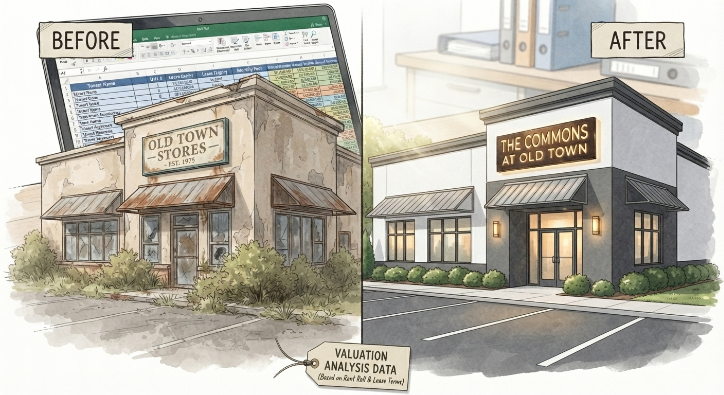
Most articles on how to increase commercial property value read the same way: repaint the lobby, add some landscaping, improve the signage. None of that is wrong exactly, it is just incomplete. The real question an owner should be asking is not “what improvement looks nice” but “which improvement actually moves net operating income, and by how much.”
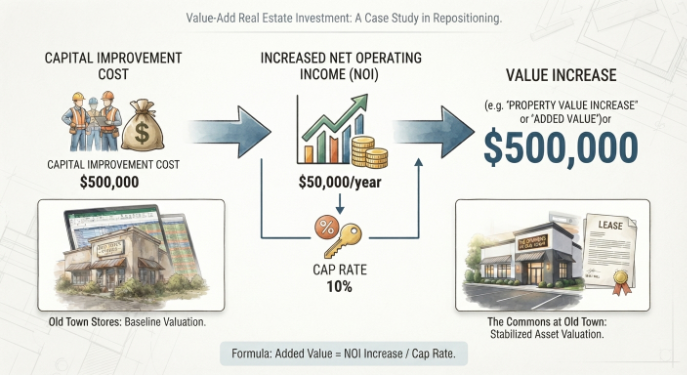
A useful way to think about this is that a commercial property’s value is really just a reflection of the income it produces, filtered through a cap rate. So every improvement worth considering should trace back to one of three outcomes: more income, lower expenses, or reduced risk in the eyes of a future buyer or lender.
Increasing Rental Income
The most direct lever is rent itself. This can come from raising rents to market level at renewal, adding income producing amenities like storage units or reserved parking, or converting underused space into leasable square footage. Before pushing rents aggressively, though, it is worth checking current comparable asking rents in the submarket so increases stay realistic rather than triggering turnover you did not want.
Reducing Vacancy and Improving Tenant Retention
Every month a unit sits empty is lost income that never returns. Reducing vacancy usually comes down to responsive property management, competitive lease terms, and addressing tenant complaints before they become move out decisions. Retention is often cheaper than releasing space, since turnover brings marketing costs, lost rent during the vacancy period, and frequently a tenant improvement allowance for the next occupant.
Physical Improvements That Actually Matter
Curb appeal and common area renovations do matter, but their value comes from what they change behaviorally: do they reduce vacancy, support higher asking rents, or shorten time on market. Improvements worth prioritizing typically include:
- Renovated common areas and lobbies that support premium rent positioning
- Updated signage that improves visibility and tenant traffic for retail
- Parking improvements, particularly restriping or expanding capacity in tight markets
- Security upgrades, including cameras and access control, which tenants increasingly expect
- Landscaping that supports first impressions during leasing tours
Energy Efficiency and Building Systems
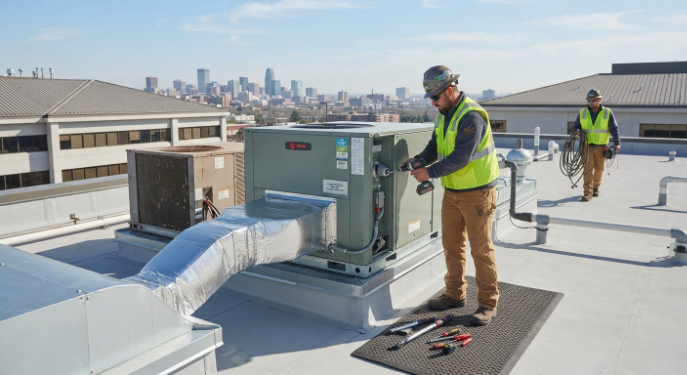
Energy efficiency improvements sit at an interesting intersection: they reduce operating expenses directly, which raises NOI without needing a single new tenant. HVAC upgrades, LED lighting retrofits, and better building envelope insulation all reduce utility costs, and in many commercial leases where tenants pay their own utilities, efficient systems also make the space more attractive to prospective tenants comparing multiple properties.
Preventive Maintenance vs Deferred Maintenance
Preventive maintenance protects value. Deferred maintenance quietly erodes it, and often shows up at the worst possible time, during a buyer’s physical inspection. A well documented preventive maintenance program can also support a lower perceived risk profile with buyers and lenders, which can influence the cap rate a buyer applies to the property.
Property Repositioning and Tenant Mix
Sometimes the highest value improvement is not physical at all. Repositioning a property, shifting from a struggling tenant mix to one better matched to current demand, can meaningfully change both income and marketability. A retail center anchored by a declining tenant category may benefit more from a lease restructuring strategy than from a fresh coat of paint.
Lease Optimization
Beyond rent levels, lease structure itself affects value. Longer lease terms, built in rent escalations, and stronger tenant covenants all reduce the income risk a buyer is pricing in. Two properties with identical current NOI can have meaningfully different values if one has stable, long term leases and the other is full of short term or month to month tenants.
Capex ROI and Commercial Property Value
This is the section that actually answers the underlying question: is a specific improvement financially worth doing. Also read What Is a Good NOI for Commercial Property?
The basic relationship is straightforward. Start with the annual increase in NOI the improvement is expected to produce, then divide by the cost of the improvement to get a simple return figure. Separately, divide that same NOI increase by the market cap rate to see how much the improvement could add to the property’s value.
Formulas:
Capex ROI = Annual NOI Increase ÷ Capital Improvement Cost
Potential Value Increase = Annual NOI Increase ÷ Cap Rate
Hypothetical Example
Suppose an owner is considering a $50,000 lighting and HVAC efficiency upgrade for a small office building, purely as a hypothetical scenario.
| Item | Value |
| Capital Improvement Cost | $50,000 |
| Estimated Annual Expense Savings | $6,000 |
| Market Cap Rate | 7% |
Capex ROI = $6,000 ÷ $50,000 = 12% annual return
Potential Value Increase = $6,000 ÷ 0.07 = $85,714
In this hypothetical case, a $50,000 investment could potentially create over $85,000 in added value, because the cap rate effectively multiplies the impact of sustained NOI growth. That gap is exactly why the highest cost improvement is not automatically the best investment. A $150,000 lobby renovation that produces no measurable NOI increase could add nothing to value under this framework, while a smaller, less visually dramatic mechanical upgrade could move the number significantly, provided the savings are real and sustainable rather than a one time reduction.
It is worth repeating that these figures are entirely hypothetical. Real world results depend on actual utility rates, tenant lease structures, market cap rates, and whether savings genuinely persist year over year.
A Practical Prioritization Framework
When comparing multiple potential improvements, it helps to weigh them across the same criteria rather than picking whatever feels most urgent that week.
| Factor | Why It Matters |
| Cost | Determines capital outlay and payback period |
| Potential NOI Impact | Directly affects value through the cap rate |
| Tenant Impact | Influences retention and lease renewal odds |
| Maintenance Savings | Reduces ongoing operating expenses |
| Payback Period | Shorter payback generally means lower risk |
| Marketability | Affects how quickly the property leases or sells |
| Long Term Value | Considers durability of the improvement itself |
Improvements that score well across several of these categories, not just one, tend to be the strongest candidates.
Real World Example
Consider a hypothetical strip center owner, David, weighing two options with a $40,000 budget: repaving the parking lot or upgrading exterior lighting and signage. The parking lot addressed a real maintenance issue but was unlikely to change rent levels.
The lighting and signage upgrade, by contrast, was projected to support a modest rent increase across several retail bays at renewal. Using the capex ROI framework, the signage and lighting project showed a stronger connection to NOI growth, even though the parking lot arguably had more visible wear. David ultimately phased both projects, prioritizing the one with a clearer path to increased income first.
FAQ
What is the fastest way to increase commercial property value? Improvements that directly raise NOI, whether through higher rents, reduced vacancy, or lower operating expenses, tend to have the fastest and most measurable impact on value.
Does every renovation increase commercial property value? No. A renovation only increases value to the extent it increases NOI or meaningfully reduces perceived risk to a buyer or lender.
How do I calculate capex ROI for a property improvement? Divide the expected annual NOI increase by the cost of the improvement to get a simple return percentage, then divide the same NOI increase by the market cap rate to estimate the potential value impact.
Why does a small improvement sometimes add more value than an expensive one? Because value increases are tied to sustained NOI growth divided by the cap rate, not to the visual size or cost of the project itself.
Is energy efficiency really worth it for commercial property value? It can be, since reduced utility and maintenance expenses flow directly into higher NOI, which then compounds through the cap rate.
Should I prioritize tenant retention or new leasing to increase value? Both matter, but retention is often more cost efficient since it avoids vacancy loss, marketing costs, and new tenant improvement allowances.
How does lease structure affect commercial property value? Stronger, longer term leases with reliable tenants reduce income risk, which can support a lower cap rate and therefore a higher value for the same NOI.
Conclusion
Figuring out how to increase commercial property value comes down to one consistent question: does this improvement move net operating income, and by how much. Cosmetic upgrades have their place, but the improvements that genuinely move the needle are the ones that show up in a spreadsheet, not just in a walk through. Run the capex ROI math before committing capital, prioritize projects using more than gut feeling, and remember that in commercial real estate, the smartest investment is rarely the flashiest one.
Leave a Reply