
If you have ever signed a commercial lease on behalf of a small business, there is a good chance you were asked to sign something else along with it: a personal guarantee. Understanding a commercial lease personal guarantee explained in plain language, rather than dense legal terminology, matters because this single clause can determine whether your personal assets are protected if the business struggles.
A personal guarantee is a promise, separate from the lease itself, in which an individual agrees to be personally responsible for the tenant’s lease obligations if the business entity fails to pay. Landlords ask for these because a newer or smaller business often has limited assets and no long financial track record, which makes a lease with that business alone feel riskier than one backed by a guarantor’s personal finances. Tenants resist them for the opposite reason: a personal guarantee can put a home, savings, or other personal assets at risk over a business decision.
This article walks through what a personal guarantee actually is, why it matters to both sides of a lease, and how landlords and tenants commonly negotiate its terms. Also read Red Flags When Buying a Commercial Property.
What a Personal Guarantee Actually Is
Under the legal definition used by Cornell Law School’s Legal Information Institute, a guaranty is a promise from a guarantor that acts as a form of security for another party’s underlying obligation, and it typically only becomes enforceable once the primary party fails to perform. In a commercial lease, that means the guarantor is not paying rent every month.
The tenant business is expected to pay rent as normal. The personal guarantee only comes into play if the tenant defaults, at which point the landlord can pursue the guarantor personally for the unpaid obligation.
This is different from a security deposit, which is money the landlord already holds and can apply to unpaid rent or damages. It is also different from a corporate guarantee, where a parent company or affiliated business, rather than an individual, backs the lease obligations of the tenant entity.
Why Landlords Request a Personal Guarantee

A commercial lease is a long term financial commitment, often spanning three to ten years or more. If a landlord signs a lease with a newly formed LLC that has no operating history and minimal capital, the lease is only as strong as that entity’s ability to pay. A personal guarantee gives the landlord recourse beyond the business itself, which reduces the landlord’s risk when negotiating the deal.
This is particularly common with:
- Startups and newly formed business entities
- Businesses with limited credit history
- Single location tenants without a broader corporate backing
- Retail and restaurant concepts, which landlords often view as higher risk categories
Why Tenants Resist a Personal Guarantee
Part of the appeal of forming a limited liability company or corporation is the separation between business liability and personal liability. A personal guarantee undoes that protection specifically for the lease, exposing the guarantor’s personal assets even though the business itself is structured to limit that exposure.
A tenant asked to sign a personal guarantee is effectively being asked to take on a business risk personally, which is why many business owners try to limit, cap, or eliminate this requirement during lease negotiations.
What Happens if a Tenant Defaults
If a tenant defaults on a guaranteed lease, the landlord can typically pursue the guarantor for unpaid rent and, depending on the guarantee language, other lease obligations such as remaining term liability or damages related to re-leasing the space.
The exact process and what a landlord can recover depend heavily on the specific guarantee language in the lease and the laws of the state where the property is located. This is general educational information, not legal advice, and the actual enforcement of a guaranty in any specific case depends on the contract terms and applicable jurisdiction.
How to Negotiate a Commercial Lease Personal Guarantee
A full, unlimited personal guarantee is rarely the only option on the table. Several structures exist that reduce the guarantor’s exposure while still giving the landlord meaningful protection.
Limited or Capped Guarantee
Instead of guaranteeing the entire remaining lease term, a limited guarantee caps the guarantor’s liability at a specific dollar amount or a set number of months of rent. This gives the landlord a defined worst case scenario while giving the tenant a known ceiling on personal exposure.
Time Limited Guarantee
A time limited guarantee applies only for a defined period, such as the first two or three years of the lease, after which the guarantee expires and the tenant entity stands on its own.
Burn Off Provision
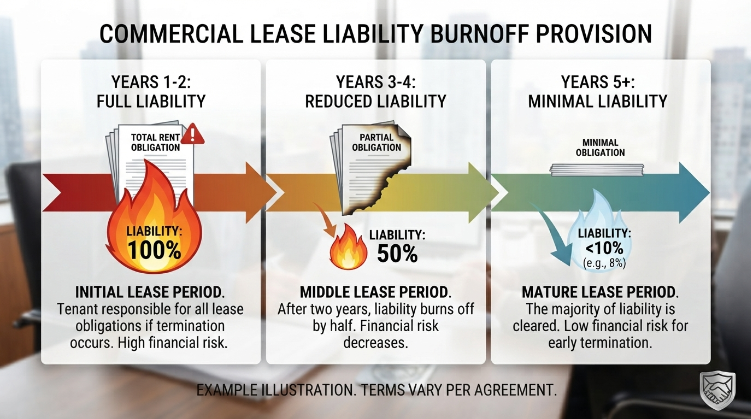
A burn off provision reduces or eliminates the guarantor’s liability over time as the tenant meets certain conditions, such as a consistent on time payment history or reaching specific revenue milestones. This structure rewards a track record of performance by gradually reducing personal risk.
Good Guy Guarantee
In some markets, particularly for certain retail and commercial leases, a good guy guarantee limits the guarantor’s liability to the period during which the tenant actually occupies the space, provided the tenant vacates properly and in good condition. This structure is not universally available and depends heavily on local market custom and the specific lease language negotiated.
Reduced Guarantee After Payment History
Some leases include a provision that reduces guarantee exposure after a defined period of consistent, on time rent payment, functioning similarly to a burn off but tied specifically to payment performance rather than time alone.
Security Deposit or Letter of Credit Instead of a Broader Guarantee
A tenant may propose a larger security deposit or a letter of credit in place of, or in addition to, a personal guarantee. A letter of credit is a bank issued financial instrument that guarantees payment up to a specified amount, giving the landlord a defined and liquid source of recovery without attaching personal liability to an individual guarantor.
Corporate Guarantee
If the tenant entity is affiliated with a larger, more established company, a corporate guarantee from that parent entity can sometimes replace an individual’s personal guarantee, shifting the risk to a business balance sheet rather than a person.
Financial Covenant Based Protections
In some negotiations, rather than a personal guarantee, the landlord accepts financial reporting requirements or covenants that allow early intervention if the tenant’s financial condition weakens, giving the landlord visibility without requiring personal liability.
How Landlords, Tenants, and Guarantors See This Differently
From a landlord’s perspective, the personal guarantee is a risk management tool, and the strength of the guarantor’s personal finances directly affects how comfortable the landlord feels approving the lease. From a tenant’s perspective, the guarantee is a personal risk that ideally should be limited, capped, or phased out over time as the business proves itself.
From a guarantor’s perspective, who may or may not be the same person as the business owner, the primary concern is understanding exactly what circumstances could trigger personal liability and how long that exposure lasts.
Hypothetical Negotiation Example
Consider a hypothetical scenario. A landlord initially requires a full personal guarantee covering the entire five year lease term for a new restaurant tenant. The tenant, concerned about exposing personal assets over a full five year commitment, counters by requesting no personal guarantee at all, offering instead a security deposit equal to three months’ rent.
In this hypothetical negotiation, the two sides might land on a middle position: a personal guarantee capped at eighteen months of rent, with a burn off provision that reduces the cap by six months for every twelve consecutive months of on time payment, effectively eliminating the guarantee entirely by the start of year three if the tenant maintains a clean payment history.
This structure gives the landlord meaningful protection during the riskiest early period of the lease, while giving the tenant and guarantor a clear, achievable path to reducing personal exposure. This example is illustrative only and any actual negotiation outcome depends on the specific parties, market, and lease terms involved.
What to Review Before Signing a Personal Guarantee
- Scope: does the guarantee cover rent only, or also damages, legal fees, and other lease obligations
- Duration: is the guarantee tied to the full lease term, a limited period, or a burn off schedule
- Maximum liability: is there a dollar cap or a cap tied to a specific number of months of rent
- What triggers default under the guarantee, and how that aligns with the default provisions in the lease itself
- Whether the guarantee extends to renewal periods or lease amendments signed after the original agreement
- Release conditions, including exactly what the tenant must do to trigger a release or reduction
- Burn off conditions, including how payment history or revenue milestones are measured and verified
- Whether legal fees and collection costs are included within the guaranteed amount
Because a personal guarantee is a binding legal commitment separate from the lease itself, it is strongly recommended that both landlords and tenants have any actual lease and guarantee reviewed by a qualified real estate attorney before signing, since enforceability and specific legal effect vary by state and by the exact language used in the document.
Final Thoughts
A commercial lease personal guarantee explained clearly comes down to one core idea: it is a separate promise that puts an individual’s personal assets behind a business’s lease obligations. Landlords request it to reduce risk on a long term financial commitment, and tenants and guarantors have legitimate reasons to want that exposure limited, capped, or phased out over time.
Understanding the available negotiation structures, from capped guarantees to burn off provisions to letters of credit, gives both sides a realistic path to a lease that protects the landlord’s interest without placing unlimited personal risk on the guarantor.
FAQ
What is a personal guarantee on a commercial lease? A personal guarantee is a separate agreement in which an individual promises to personally cover the tenant’s lease obligations if the business entity fails to pay. It only becomes enforceable after a default by the primary tenant.
Can a personal guarantee on a commercial lease be negotiated? Yes. Common negotiation approaches include capping the guarantee at a specific dollar amount, limiting it to a set time period, or including a burn off provision that reduces liability after a consistent payment history.
What is a burn off provision in a commercial lease guarantee? A burn off provision gradually reduces or eliminates a guarantor’s liability over time, typically as the tenant demonstrates consistent on time rent payments or meets other agreed conditions.
Is a personal guarantee the same as a security deposit? No. A security deposit is money the landlord already holds and can apply toward unpaid rent or damages. A personal guarantee is a promise of future payment from an individual and only comes into play after a default, when the landlord must pursue the guarantor directly.
What is the difference between a corporate guarantee and a personal guarantee? A personal guarantee is backed by an individual’s personal assets. A corporate guarantee is backed by a business entity, often a parent company or affiliated business, rather than an individual person.
Can a letter of credit replace a personal guarantee? In some negotiations, yes. A letter of credit is a bank issued instrument that guarantees payment up to a set amount, giving the landlord a defined source of recovery without attaching liability to an individual. Whether a landlord will accept this in place of a personal guarantee depends on the specific deal and the landlord’s risk tolerance.
Do all commercial leases require a personal guarantee? No. Established businesses with strong financials, larger corporate tenants, or tenants offering alternative security such as a larger deposit or letter of credit may be able to negotiate a lease without any personal guarantee at all.
Leave a Reply