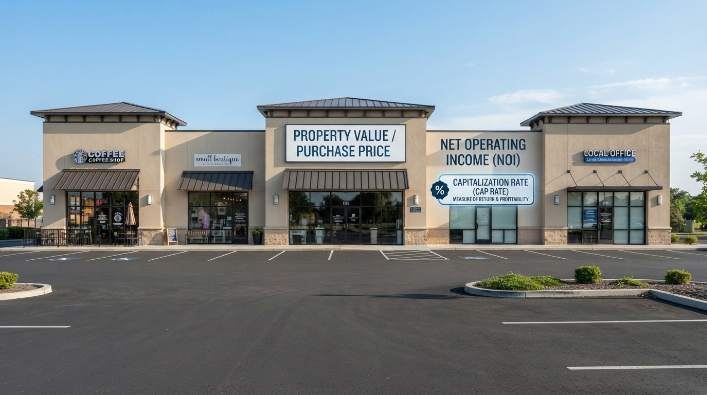
A broker sends you a listing for a small retail strip. The asking price looks reasonable. The rent roll looks healthy. And then someone in the deal chat asks, “What’s the cap rate?” and the room goes quiet for a second longer than it should.
If you have ever felt that pause, you already know why learning how to calculate cap rate on commercial property matters. It is not a complicated formula once you understand what goes into it, but it is easy to get wrong if you skip a step or mix up which expenses belong where. This guide walks through the calculation in plain terms, with a full worked example, so you can run the numbers on your next deal with confidence.
What Cap Rate Actually Tells You
Cap rate, short for capitalization rate, is a snapshot of the return a property generates relative to its price, based purely on income and expenses. It ignores financing. It ignores appreciation. It is a single number that lets you compare an office building in one part of town to a warehouse across the state on roughly equal footing.
A practical way to look at it is this: cap rate answers the question, “If I paid cash for this property today, what percentage return would the income alone produce in year one?” That framing matters because a lot of buyers confuse cap rate with total return, which also includes debt paydown, tax benefits, and any increase in property value over time.
The Cap Rate Formula
The formula itself is short:
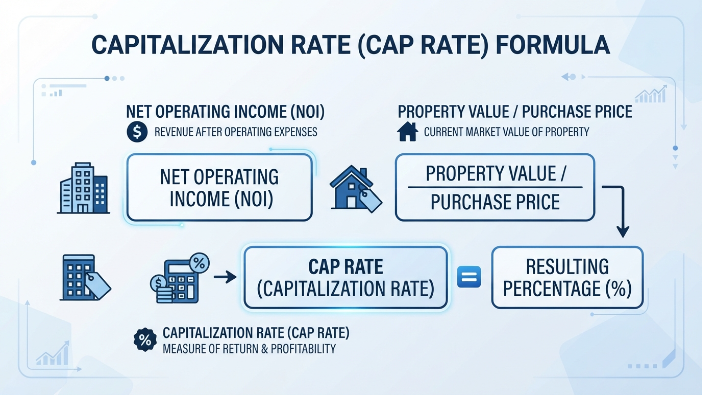
Cap Rate = Net Operating Income (NOI) / Current Market Value
Two numbers, one division. The complexity lives inside the NOI figure, not in the formula itself.
Step 1: Calculate Net Operating Income
Net operating income is what remains after you subtract operating expenses from the property’s income, before accounting for financing costs, income taxes, and depreciation.
NOI = Gross Rental Income (minus vacancy and credit loss) − Operating Expenses
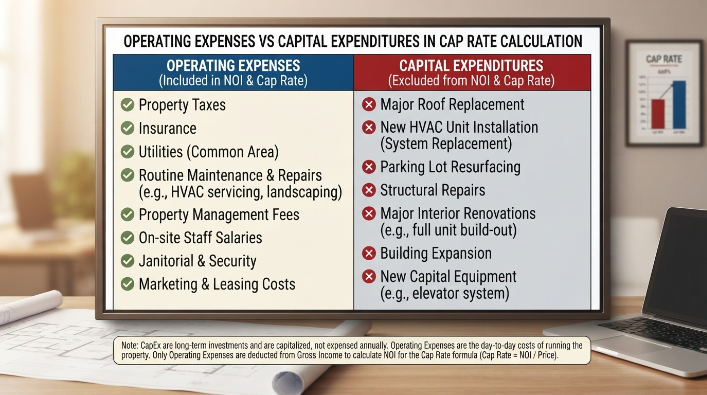
Operating expenses typically include property taxes, insurance, repairs and maintenance, property management fees, and utilities not covered by tenants. What NOI does not include: mortgage payments, capital expenditures like a roof replacement, and income taxes. One mistake I often see is investors folding debt service into their expense line, which quietly deflates the cap rate and makes a property look worse than it actually performs on an unleveraged basis.
Step 2: Divide NOI by the Property’s Value
Once you have a clean NOI figure, divide it by the current market value or purchase price. The result, multiplied by 100, is your cap rate as a percentage.
Worked Example: Calculating Cap Rate Step by Step
Say you are evaluating a small commercial building listed at $1,200,000.
- Gross potential rental income: $150,000 per year
- Vacancy and credit loss allowance: 5%, or $7,500
- Effective gross income: $142,500
- Operating expenses (taxes, insurance, maintenance, management): $52,500
NOI = $142,500 − $52,500 = $90,000
Cap Rate = $90,000 / $1,200,000 = 0.075, or 7.5%
That 7.5% figure is what you would use to compare this property against similar listings, assuming both NOI calculations were built the same way. If a competing property advertises a lower cap rate but its seller calculated NOI without deducting a realistic vacancy allowance, the two numbers are not actually comparable, even though they look like they are.
Real World Example: Cap Rates Moving Into 2026
Cap rate behavior varies significantly by property type, and it has been shifting. According to CoStar Group’s late 2025 forecast, industrial and multifamily properties experienced cap rate compression through the second half of 2024 into 2025 as vacancies peaked and rent growth began accelerating, while office and retail cap rates largely moved sideways with easing upward pressure heading into 2026
That distinction matters when you are running your own numbers. A cap rate that looked attractive for an industrial asset eighteen months ago may not represent current market pricing today, and the reverse can be true for office product. Always check where cap rates for your specific asset type and market currently sit before assuming your calculated number is competitive.
Common Mistakes When Calculating Cap Rate
- Using pro forma income instead of actual trailing income. Sellers sometimes present optimistic future rent projections as if they were current income. Ask for trailing twelve month operating statements.
- Forgetting a vacancy allowance on a fully leased property. Even a property that is 100% occupied today should be underwritten with a reasonable vacancy assumption, because tenants eventually turn over.
- Mixing up market value and purchase price. These can differ, particularly in off market deals. Be clear about which figure you are dividing into.
- Comparing cap rates across different property types without context. A 6% cap rate on a multifamily asset and a 6% cap rate on a single tenant retail building do not carry the same risk profile.
- Including capital expenditures in operating expenses. A new roof or HVAC replacement is a capital cost, not a recurring operating expense, and belongs in a separate line item.
What Counts as a Good Cap Rate in 2026
There is no single “correct” cap rate. What is considered strong depends on property type, location, tenant quality, and the buyer’s own risk tolerance.
Lower cap rates generally reflect lower perceived risk and stronger locations, while higher cap rates usually signal higher risk, secondary markets, or shorter lease terms remaining. When evaluating a commercial property, I would treat the cap rate as a starting point for further questions rather than a final verdict on whether the deal works.
Because cap rates vary this much by asset class and geography, it is worth checking current data for your specific market and property type through a commercial brokerage research report before finalizing an offer, rather than relying on a single national average.
Cap Rate Limitations to Keep in Mind
Cap rate is a useful screening tool, but it has real limits. It does not account for financing terms, which means two buyers using different loan structures on the same property will see very different cash on cash returns despite an identical cap rate.
It also does not capture future appreciation, lease rollover risk, or the cost of deferred maintenance that might not show up in a single year’s operating statement. Treat cap rate as one input in a broader underwriting process, not the whole analysis.
Conclusion
Calculating cap rate on commercial property comes down to two disciplined steps: build an accurate net operating income figure, then divide it by the property’s value. The formula is simple.
The judgment involved in building a clean NOI, and interpreting what the resulting number actually means for a specific property type and market, is where real underwriting skill shows up.
Run the numbers carefully, compare them against current data for similar assets, and use cap rate as one part of a fuller picture before making a decision on your next commercial property purchase.
Frequently Asked Questions
What is the formula to calculate cap rate on commercial property?
Cap rate equals net operating income divided by the property’s current market value or purchase price, expressed as a percentage.
Is a higher or lower cap rate better?
It depends on your goals. Lower cap rates typically reflect lower risk and stronger locations, while higher cap rates usually reflect higher risk or return potential. Neither is universally better.
Does cap rate include mortgage payments?
No. Cap rate is calculated before financing costs, so it reflects the property’s performance independent of how it is financed.
What is a good cap rate for commercial property in 2026?
It varies by property type and market. Industrial and multifamily assets have generally seen cap rate compression recently, while office and retail have moved more sideways, so comparing your target property against current data for its specific category is more useful than relying on one universal number.
Can cap rate be negative?
Technically yes, if operating expenses exceed income, producing a negative NOI. In practice this signals a distressed or mismanaged property rather than a normal investment scenario.
How is cap rate different from cash on cash return?
Cap rate ignores financing and measures unleveraged return. Cash on cash return factors in your actual mortgage payments and measures return on the cash you personally invested.
Leave a Reply