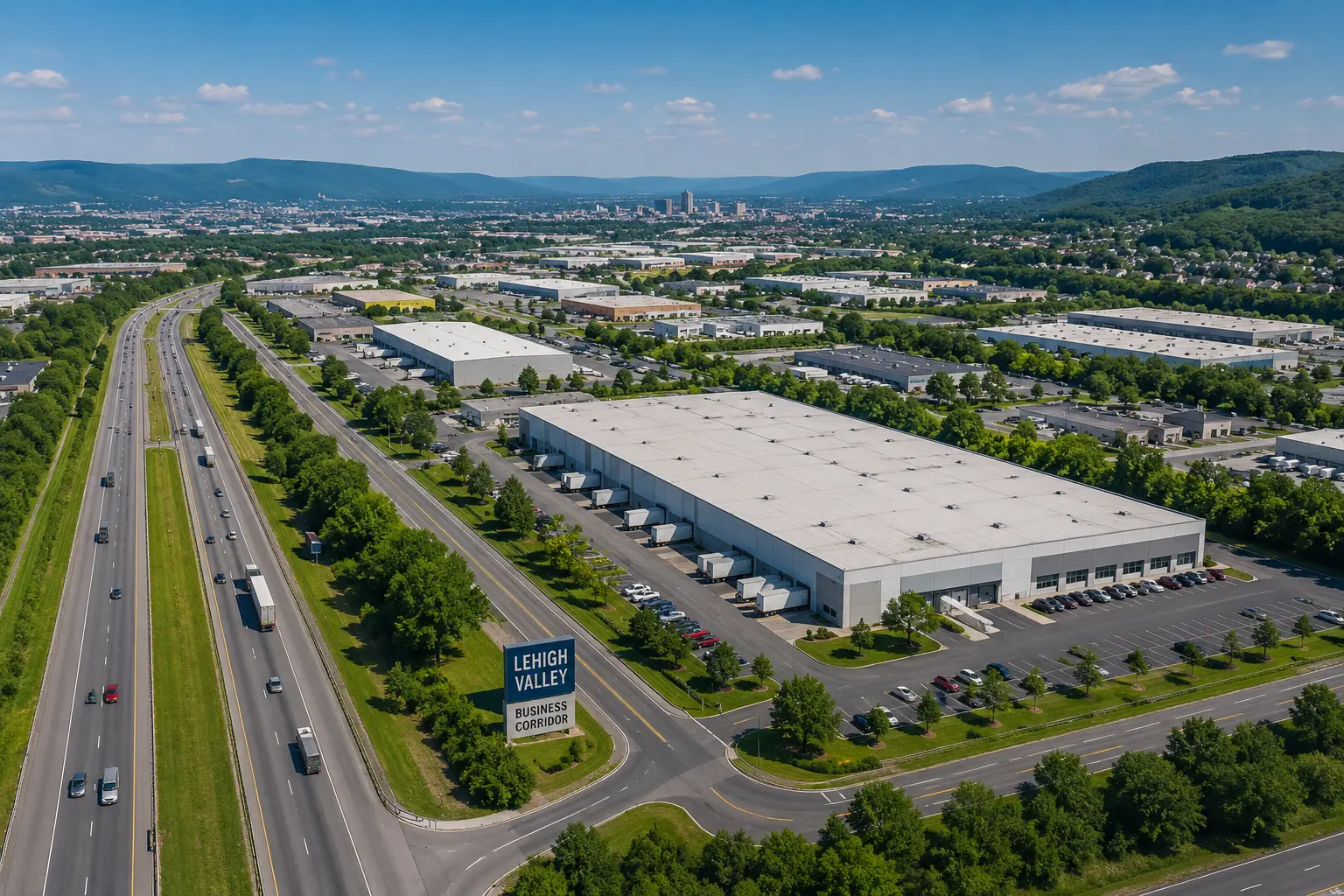
The Lehigh Valley has quietly become one of the most active commercial real estate markets on the East Coast. Sitting between New York City and Philadelphia, this Pennsylvania region keeps attracting manufacturers, logistics companies, retailers, and investors who want lower costs without giving up access to major metro areas.
If you own commercial property here, lease space, or are thinking about investing, 2026 is shaping up to be a year of real change. Some sectors are tightening. Others are adjusting. And a handful of new developments are about to reshape what “commercial real estate” even means in this region.
This guide breaks down what’s happening across the Lehigh Valley’s industrial, office, and retail markets, what it means for property owners, and what practical steps you can take right now.
Why the Lehigh Valley Keeps Attracting Commercial Investment
Three things make this market different from most mid-sized metro areas.
First, location. The intersection of the Pennsylvania Turnpike and Route 78 puts businesses within a day’s drive of roughly a third of the U.S. and Canadian population. That single fact has driven decades of industrial growth and continues to shape leasing decisions today.
Second, cost. Commercial rents and land prices remain well below comparable space in northern New Jersey, New York, or Philadelphia, while still offering highway access to those same markets.
Third, population growth. The Lehigh Valley’s population has grown by 240,000 people since 1970, and if current trends hold, Lehigh and Northampton counties combined are expected to surpass 800,000 residents by 2050. More residents means more demand for retail, healthcare, and services — which directly affects commercial leasing across the region.
This combination of geography, affordability, and population growth is why understanding commercial real estate fundamentals matters so much here. If you haven’t already, it’s worth reviewing the real cost of vacancy in commercial properties alongside this guide, since vacancy trends and market opportunity are closely linked.
The Industrial Market: Still the Backbone, But Changing Shape
Industrial real estate has driven the Lehigh Valley’s commercial growth for over a decade, and it’s still the largest piece of the puzzle. But the type of industrial demand is shifting.
Industrial vacancy reached 9.3% in early 2026, with smaller industrial buildings under 100,000 square feet seeing much stronger demand at a 4.8% vacancy rate, compared to 10.9% for larger facilities. That gap matters. It tells owners and investors that bigger isn’t automatically better right now — smaller, flexible industrial space is leasing faster than oversized distribution centers. Lehighvalley
Some industrial reports show a slightly different picture depending on the data source and submarket. One regional analysis put Lehigh Valley industrial vacancy at 7.4% in the first quarter of 2026, down from 8.73% in the previous quarter, with 2.6 million square feet leased across multiple deals during the period. Either way, the takeaway is the same: leasing activity remains healthy, even if vacancy has crept up from the pandemic-era highs. Lehigh Valley Business
Warehousing Is Slowing, Data Centers Are Rising
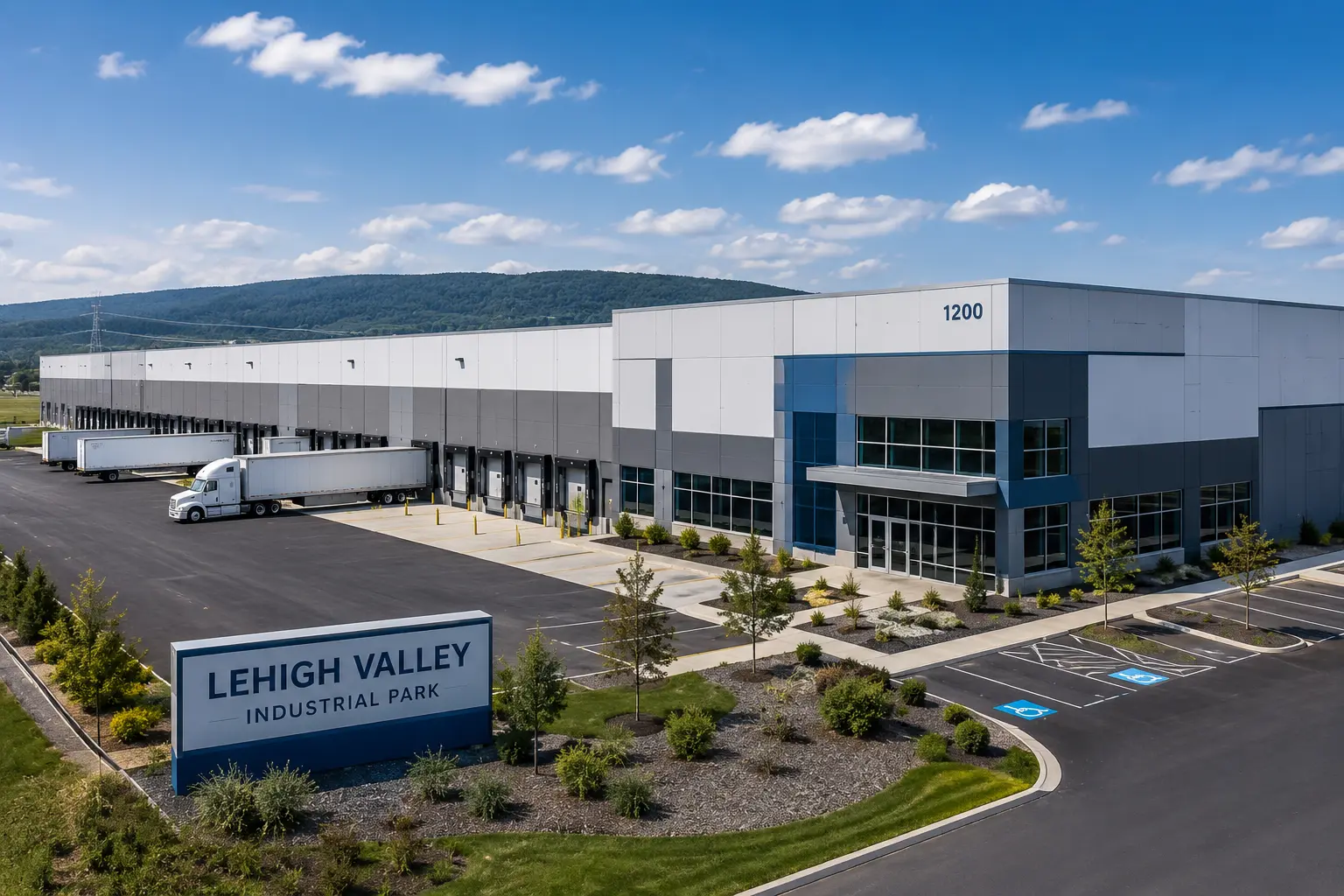
Industrial development still accounts for the largest share of commercial activity in the region, but the type of industrial space being built is changing — only about half of the 5.8 million square feet of nonresidential development reviewed in early 2026 was traditional warehousing and logistics space. The rest is shifting toward next-generation uses, including data centers.
This is a meaningful signal for property owners. If you own or are considering industrial property, it’s no longer safe to assume “build a warehouse and they will come.” Local planning bodies are already adjusting zoning and use guides to account for this shift, which means owners who plan ahead for flexible or specialized industrial use will have an advantage over those who don’t.
Why Logistics Still Matters
Even with the slowdown from pandemic-era peaks, logistics remains central to the region’s identity. Logistics and warehousing continue to dominate the Lehigh Valley commercial real estate marketplace because of the area’s lower real estate costs compared to nearby markets and its proximity to major ports and population centers.
Practical takeaway: If you’re holding industrial property, smaller, well-located buildings are currently outperforming oversized ones. Reassess your portfolio with that in mind rather than assuming all industrial space behaves the same way.
The Office Market: Stable, But Increasingly Polarized
Office space in the Lehigh Valley isn’t experiencing the dramatic vacancy spikes seen in larger metro areas, but it’s not immune to the broader shift toward hybrid work either.
Office vacancy in the region remained roughly consistent with previous quarters at 7.7% in the first quarter of 2026. That’s a relatively healthy number compared to many U.S. metros, where overall office vacancy has climbed well into the high teens.
Property class matters here. Roughly 31% of total office listings in the Lehigh Valley are Class A, about 62% are Class B, and only around 6.5% are Class C. Class A office space commands an average rent of about $20.67 per square foot, while Class B space averages closer to $17.90 per square foot.
What This Means for Owners
Newer, higher-amenity buildings are still finding tenants. Older, undifferentiated Class B and C space is where owners face the most pressure. Buildings completed or substantially renovated since 2000 make up less than 30% of total office inventory in the region. That leaves a large share of aging office stock competing for a shrinking pool of tenants who increasingly expect modern layouts, better HVAC systems, and flexible floor plans.
If you own office property built before 2000 and haven’t renovated recently, this is the moment to evaluate whether targeted upgrades — not full redevelopment, but meaningful ones — could reposition the asset competitively. Reviewing your property’s net operating income before committing capital to renovations is a smart first step, since not every upgrade pays for itself in higher rent or faster lease-up.
Common mistake to avoid: Treating all office vacancy as the same problem. A 7.7% market average hides a much bigger gap between in-demand modern space and aging buildings that are struggling to lease. Generic capital improvements without a tenant-demand analysis can waste money on the wrong upgrades.
The Retail Market: A Genuine Bright Spot
If there’s one sector outperforming expectations in the Lehigh Valley right now, it’s retail.
While the national retail vacancy rate sits around 10.8%, Lehigh Valley retail vacancy is just 4.4%, one of the lowest levels the region has ever recorded. That’s a striking contrast to the “retail apocalypse” narrative that dominates national headlines.
What’s Driving Retail Demand
A few forces are converging here. Migration from northern New Jersey and other high-cost areas has accelerated since the pandemic, with new residents and businesses drawn to the Lehigh Valley’s lower taxes and more affordable space.
Tenant demand is also diversifying. Restaurant groups remain especially active, with five to ten sit-down operators searching for new locations at any given time, while medical tenants — including hospital systems acquiring retail-style properties for urgent care and outpatient facilities — have become a major leasing force. Experiential retail concepts, like golf simulators and family entertainment venues, are also gaining ground, though limited available space is restricting how many of these tenants can enter the market.
Mixed-Use Is the Next Frontier
One of the more interesting structural shifts is the rise of suburban mixed-use development. Projects combining residential units with ground-floor retail are now appearing in suburban settings outside the traditional urban centers of Allentown, Bethlehem, and Easton — a departure from the region’s historical retail model.
For property owners, this is worth watching closely. Curating the right tenant mix in a mixed-use project requires far more planning than a standalone retail strip. Rent expectations, parking ratios, and tenant compatibility all need to be set realistically before construction even begins — not adjusted after the fact.
Practical takeaway: If you own retail property in a tight submarket, you likely have leverage right now. Use it to secure stronger lease terms, longer commitments, or better-qualified tenants rather than rushing to fill space at the first offer.
The Eli Lilly Effect: A Turning Point for the Region
No 2026 market guide would be complete without addressing the single largest commercial real estate event in Lehigh Valley history.
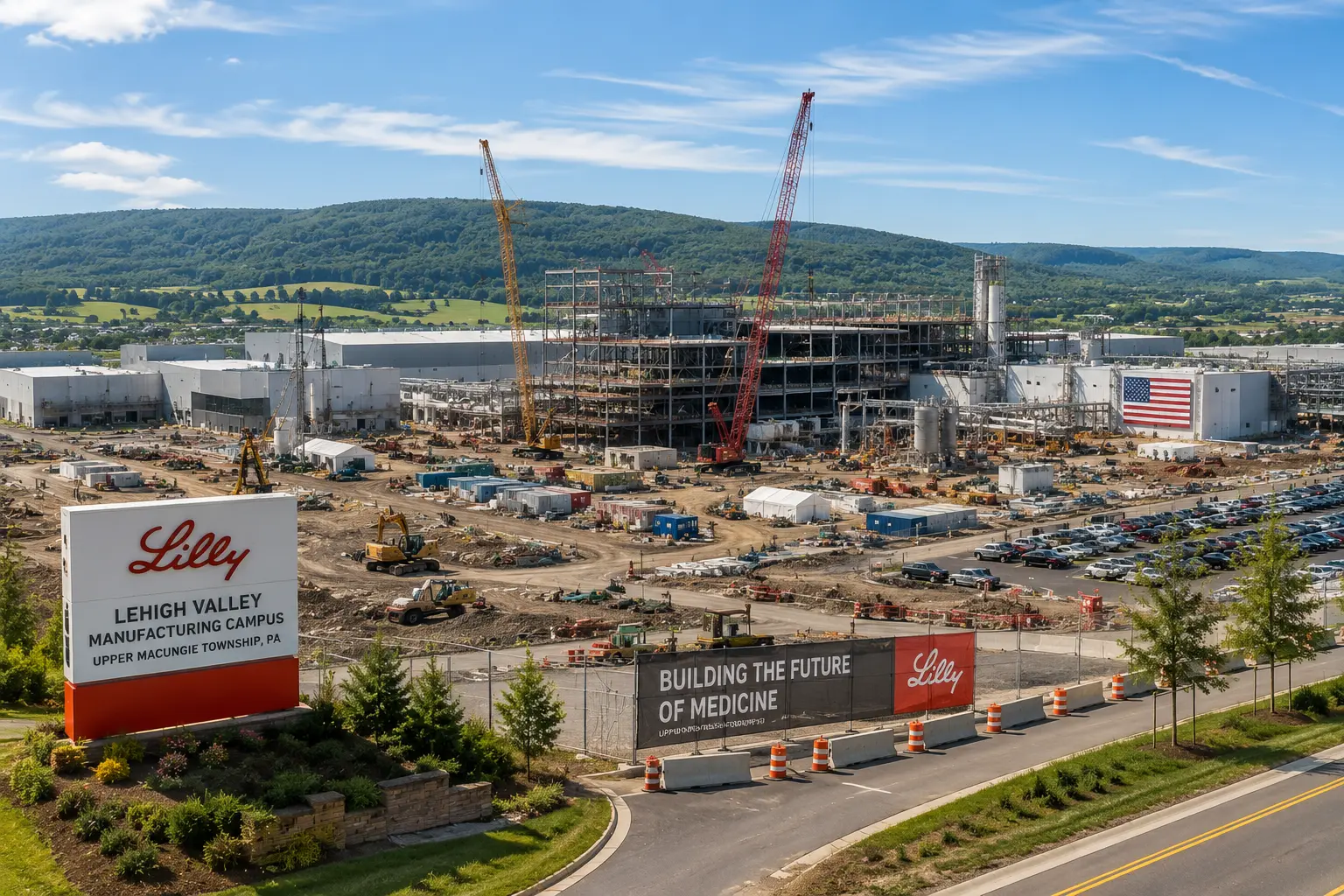
Eli Lilly and Company announced plans to build a $3.5 billion pharmaceutical manufacturing campus in Upper Macungie Township, the largest investment in the region’s history and Pennsylvania’s largest life sciences project to date. The facility is expected to bring 850 new jobs and position the Lehigh Valley as a life sciences hub.
This isn’t just one large project — it’s a signal. Regional leaders are already describing this as the start of a new era of manufacturing for the Lehigh Valley, building on the area’s long industrial history.
Why This Matters Beyond Upper Macungie
A project of this size doesn’t just affect the immediate site. It tends to pull in:
- Supporting suppliers and contractors who need nearby industrial or flex space
- New housing demand for incoming employees, which feeds back into retail and mixed-use development
- Increased interest from institutional investors who track major employer announcements as leading indicators
If you own commercial property anywhere in the broader Lehigh Valley corridor, this kind of anchor investment is worth factoring into your long-term planning, even if your property isn’t directly adjacent to the project.
Practical Steps for Property Owners and Investors in 2026
Whether you own one building or manage a portfolio, here’s how to apply these trends:
- Segment your industrial holdings by size class. Smaller, flexible buildings are outperforming large distribution centers right now. Don’t manage them with the same strategy.
- Audit office assets for age and amenities. If your building predates 2000 and hasn’t been meaningfully updated, get ahead of tenant expectations before vacancy forces your hand.
- Use retail leverage while it lasts. A 4.4% vacancy rate won’t last forever. Lock in strong tenants and favorable terms now.
- Watch anchor investments like Eli Lilly’s campus. Major announcements like this often create ripple effects in housing, retail, and supporting industrial demand for years afterward.
- Reassess regularly, not just at lease renewal. Markets are shifting quarter to quarter right now. Annual reviews aren’t frequent enough in a market this active.
Working with a team that understands these shifts in real time — rather than relying on outdated assumptions — makes a measurable difference. This is where dedicated property consulting and market research support property owners in making decisions based on current data instead of guesswork.
Common Mistakes to Avoid
- Assuming all commercial sectors move together. Industrial, office, and retail are behaving very differently right now. A strategy built for one won’t work for another.
- Ignoring submarket-level data. Regional averages (like the overall 7.4–9.3% industrial vacancy range) can hide major differences between specific corridors and building classes.
- Overbuilding without a defined use case. With industrial demand shifting away from pure warehousing, speculative construction without a clear tenant profile is riskier than it was five years ago.
- Underestimating mixed-use planning complexity. These projects require more upfront tenant and rent planning than traditional single-use retail or office buildings.
- Waiting too long to act on retail opportunity. Low vacancy rates create a seller’s/landlord’s market, but that window can close as new supply comes online.
Conclusion
The Lehigh Valley commercial real estate market in 2026 is not one story — it’s three. Industrial is shifting from raw warehousing toward more specialized uses. Office is stable overall but increasingly split between in-demand modern space and aging buildings under pressure. Retail is genuinely thriving, defying national trends thanks to strong demographics and constrained supply.
For property owners and investors, the opportunity isn’t in chasing whatever sector performed well last cycle. It’s in understanding where your specific asset fits within these shifting patterns and making decisions based on current data rather than outdated assumptions.
If you’re evaluating a commercial property in the Lehigh Valley, considering a leasing strategy, or simply trying to understand where this market is headed next, our team works directly with commercial property management and property investment support clients across the region. Learn more about who we are and how we work, or reach out directly to talk through your specific situation.
Frequently Asked Questions
Is the Lehigh Valley a good market for commercial real estate investment in 2026?
The market shows healthy fundamentals overall, with strong retail performance, stable office vacancy, and continued industrial leasing activity. As with any investment, the right opportunity depends on property type, location, and your specific goals — this article is educational and not investment advice.
Why is industrial vacancy higher than retail vacancy in the Lehigh Valley?
Industrial development expanded rapidly during the pandemic-era logistics boom, creating more supply than current demand fully absorbs in some segments. Retail, by contrast, has had limited new construction relative to demand, keeping vacancy low.
What does the Eli Lilly investment mean for local property owners?
A project of this scale typically increases demand for nearby industrial, housing, and retail space over time, even for properties not directly adjacent to the site. It’s a strong signal of long-term regional growth.
Are data centers replacing warehouses in the Lehigh Valley?
Not entirely, but the mix is shifting. Traditional warehousing still makes up a significant share of industrial development, but a growing portion of new projects involve data centers and other next-generation industrial uses.
Is now a good time to lease retail space in the Lehigh Valley?
With vacancy near historic lows, tenants face more competition for available space, while landlords generally have stronger negotiating positions. Timing depends on your specific business needs and lease terms.
What’s the difference between Class A, B, and C office space?
Class A buildings are typically newer or recently renovated with premium amenities and command the highest rents. Class B buildings are older but well-maintained and functional. Class C buildings are typically older with fewer amenities and lower rents.
How does population growth affect commercial real estate demand?
More residents generally means more demand for retail, healthcare facilities, and services, which in turn supports leasing activity and can reduce vacancy in those sectors over time.
Should I renovate an older office building or sell it?
That depends on the building’s location, condition, and the local tenant demand for that submarket. A property consultant can help evaluate whether targeted upgrades make financial sense compared to selling or repositioning the asset.